
Open Play Scheduling Software for Soft Play Centers & Play Cafes
Updated September 23, 2026
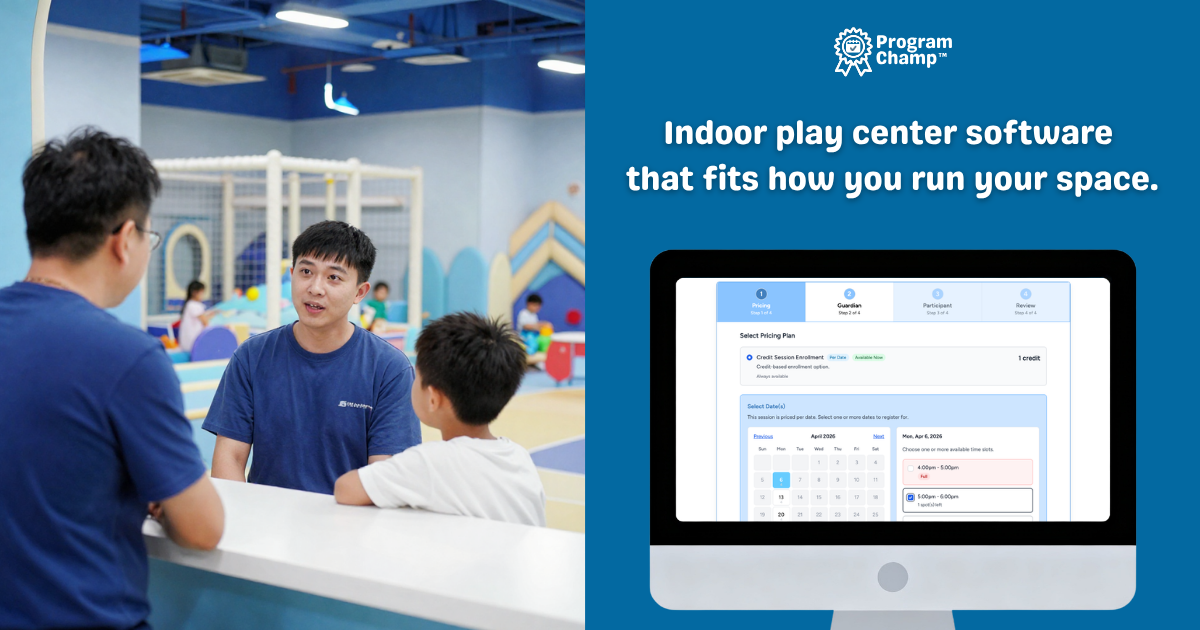
If you run a soft play center, indoor playground, or play cafe, most of your week is open play sold in fixed windows (often about two hours), plus birthday parties that fill Friday through Sunday. Adults are usually free. Kids hit a capacity cap. Families expect to reserve online or walk in against what is left. When open play and parties live in different systems, you get double-booked rooms and staff guessing which calendar is correct. Open play scheduling software and birthday party booking software should share one operational picture. See also our indoor playground software overview.
A typical play cafe week
Most successful soft play and play cafe calendars look something like this:
- Weekday mornings: toddler or sensory-friendly open play (quieter floor, lower capacity, shorter or similar 2-hour blocks).
- Weekday afternoons: after-school open play for a wider age mix when school lets out.
- Friday: shorter open play windows so the floor can flip to evening parties.
- Saturday and Sunday: morning open play, then back-to-back birthday parties (your highest-margin hours).
- Optional midweek filler: a short workshop, private hire, or no-school day camp without reinventing the schedule tool.
Your software should make that week obvious on one calendar: who paid for the 10:00 toddler block, which party holds the rainbow room at 2:00, and how many open play spots are left before walk-ins.
Session blocks, not one-off appointments
Salon-style schedulers treat every booking as independent. For indoor play, you need the same window every Tuesday, max kids per block, and waivers on file before the first visit. Open play scheduling software defines recurring time blocks (for example 9:00–11:00 a.m. toddler time, 3:00–5:00 p.m. after-school open play), lets families register or pay online, and gives your team a roster for check-in. The schedule repeats; staff are not rebuilding the same block every week.
Reserve-ahead vs walk-in
Busy weekends and popular toddler hours usually need online reserve-ahead so you do not overfill the floor. Quieter weekday slots can allow walk-ins against remaining capacity. Good indoor playground software supports both against the same session cap, instead of a separate walk-in clipboard that never matches the booking app.
Why generic booking tools struggle
A generic scheduler rarely models sibling accounts, play packs or passes, or party bookings on the same calendar. That is how teams end up with a scheduler plus a spreadsheet plus Venmo, and managers still cannot answer “who is in the building right now?” confidently. Soft play and play cafes need session capacity first, not salon appointment logic.
What to look for in indoor playground software
- Recurring session templates for blocks you run every week.
- Capacity limits per open play window with clear remaining spots.
- Online registration and payment so the front desk is not only taking cash.
- Play packs and pass-style pricing for occasional and regular families.
- Parent accounts with multiple children.
- Waivers tied to the account for faster repeat visits.
- Camps or school-break programs without a second product.
- Party inquiry or instant booking with deposits, packages, and room holds on the same calendar as open play.
Capacity, waivers, and check-in
Open play venues care about capacity per block, whether families paid before arrival, and whether waivers are on file before the first visit. Session-based software lets you cap registrations per window, see a roster at check-in, and avoid turning away a family because payment status lives in a different app. Repeat visitors move faster when guardian accounts already hold signed waivers and sibling profiles.
Birthday parties on the same calendar
Most teams need deposit collection, clear time and room holds, and a calendar the front desk trusts. You can run some packages as inquiry-first (staff convert leads) and others as instant online booking. Families pick a package, pay a deposit, and get a confirmation while managers see parties next to open play blocks and camps, reducing promises when staff already scheduled maintenance or a maxed-out Saturday.
When evaluating tools, compare how each handles your busiest day: Saturday open play blocks stacked beside back-to-back parties. Generic party-only software often lacks open play capacity rules; generic class software often lacks party deposits and room holds. ProgramChamp™ targets venues that sell both session blocks and party packages on one calendar.
How ProgramChamp™ fits
ProgramChamp™ is indoor playground software for soft play centers and play cafes that run session-based programs: open play blocks, play packs, camps, and birthday parties on one calendar. Flat $69/month, no per-student software fees. See also birthday party booking software. Start a free 30-day trial when you are ready.
Run your classes, camps, and parties with ProgramChamp™
Registration, scheduling, waivers, and parent accounts in one place — and we move your existing data across for you when you switch.